

My Journey Through Amateur Radio
I have been a licensed amateur radio operator since 1963. The magic of shortwaves and electronics fascinated me from childhood, and as a teenager in high school, I obtained my first callsign.
I was very fortunate to have a good teacher—a fellow ham radio operator, UD6BU—who organized an amateur radio club station at our school. That station became the place where I took my first steps into the world of ham radio.
The first transmitter I built was an all-tube 10-meter AM transmitter, with an 807 tube as the final amplifier. I housed it in a homemade box and used components salvaged from an old WWII V-100-B radio. For a receiver, I used an old Soviet-made military-surplus KV-M, supplemented by a three-tube frequency converter to cover 28 MHz, since the KV-M itself did not reach the 10-meter band.
It is hard to imagine today what it was like to operate on the air using so many separate pieces of equipment, each with its own controls that had to be tuned and adjusted. There were certainly none of the conveniences we now take for granted with modern transceivers. But as I remember it, that was part of the fun.
Then life took me in a different direction.
I got married, moved, started building my career, and eventually went off the air for a number of years. I was working as an engineer, and later completed my research work and received my PhD in 1977. For several years afterward, I worked in the mining industry, designing and developing transducers and control systems for coal-mining machinery.
During that period, I became very enthusiastic about building and fine-tuning audio equipment—amplifiers, turntables, tape recorders, and complete audio systems. My ham radio past had not disappeared; it was simply hiding somewhere in the background, waiting for another opportunity.
And one day, that opportunity came.
During a scientific experiment in our laboratory, I encountered some unwanted interference. I recognized it as the signal from a nearby amateur radio station. Curious, I decided to investigate and eventually found a local club station. I knocked on the door and... got hooked all over again.
Soon afterward, I obtained my new license, and this time I never parted with amateur radio.
Over the years, I have built a considerable number of different pieces of amateur radio equipment.
The first transceiver I built was the famous UW3DI, probably the most popular homebrew transceiver design in the former USSR. It was reproduced thousands of times by radio amateurs throughout the country.
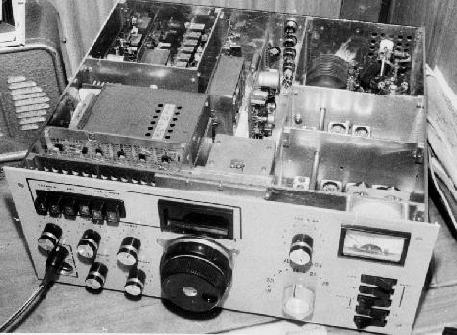
Eventually, my ego—or perhaps simply my curiosity—pushed me toward another challenge. I decided to design and build my own transceiver using single-frequency conversion and homebrew crystal filters in the IF section.
I borrowed ideas and circuits from a number of different sources, and the result was a completely new unit featuring two 9 MHz, 8-pole crystal filters—one for the receiver and another for the transmitter. The final amplifier used a Russian-made GU-19 tube. At the time, I simply did not have enough resources or experience to build a solid-state final amplifier.
The output power was only about 40–45 watts, but that didn't matter much. It was a lot of fun making contacts with something I had designed and built myself.
Before leaving the country, I gave the transceiver to a friend. For some reason, however, it didn't work properly in his house. He told me that it produced a strange AC-like hum. Perhaps there was some problem with the power-supply design. It had worked perfectly well for me, so I never had a chance to find out what went wrong.
I would have loved to troubleshoot and repair it, but that particular piece of equipment is now forever out of my reach.
What a pity.

Another project was a pair of 10-meter walkie-talkies that I built from scratch. They used long telescopic whip antennas taken from portable television sets.
The photograph below was sent to me by a friend to whom I had given the radios as a present when we left the country in 1989.

Unfortunately, I was unable to bring any of my equipment with me when we went through the complicated emigration process that existed in the Soviet Union at that time.
We left almost everything behind and arrived in the United States in early spring of 1990, after spending five months in Austria and Italy while waiting for our visas.
It was a difficult time for our entire family: a new country, a new language, no money, and no job.
But we started over.
After arriving in the United States, I worked as a test engineer for two different companies. In 1994, I began a new chapter of my career in a hospital, first as a senior engineer and later as a supervisor in the Biomedical Engineering Department.
My responsibilities covered a wide variety of activities, including clinical engineering, evaluation and testing of medical instruments, interaction with other departments and equipment manufacturers, and management of workflow.
I retired in 2016, and I have been enjoying every day of life ever since.
I received my first U.S. callsign, AA2HO, in 1991 after passing all the required examinations—including the CW examination for Extra—in one shot, going from Novice all the way to Extra.
Later, I applied for the vanity callsign N2HO, and I have used it ever since.
Today, my shack contains a Yaesu FT-1000MP HF transceiver with an Ameritron AL-811 linear amplifier. For VHF/UHF, I have a Yaesu FT-5100, FT-11R, and Kenwood TS-79A(D).
My antennas include a homemade dipole for 15 and 20 meters, two other dipoles covering 12 and 17 meters, a dipole for 10 meters, and an inverted V for 40/30 meters.
I mostly operate on HF using traditional SSB and CW. I have 321 DXCC entities confirmed out of 326 worked.
Occasionally, I also operate FT8.
My 2-meter/70-cm equipment, however, is mostly collecting dust on the shelf. I just can't find much use for it—VHF/UHF doesn't sound like much fun to me.
For a number of years, I had an 8-element Yagi for 2 meters. I used it for 2-meter packet radio through an MFJ TNC. But with the rise of the Internet, packet radio became impractical for my purposes. Telnet was much faster and far more convenient.
Eventually, I sold the TNC and took the antenna down.
And so, after all these years, I am still on the air.
The technology has changed enormously since that first homebrew 10-meter AM transmitter and the old KV-M receiver. Tubes have largely given way to transistors and integrated circuits, crystal filters have been replaced or supplemented by sophisticated digital signal processing, and the modern transceiver can do things that would have seemed like science fiction to that teenage ham in 1963.
But the basic attraction remains exactly the same.
There is still something magical about sitting in front of a radio, making an adjustment, hearing a distant voice or signal emerge from the noise, and realizing that somewhere far away, another person is listening.
That magic is what brought me into amateur radio—and it is what has kept me here.
73, George (N2HO)